


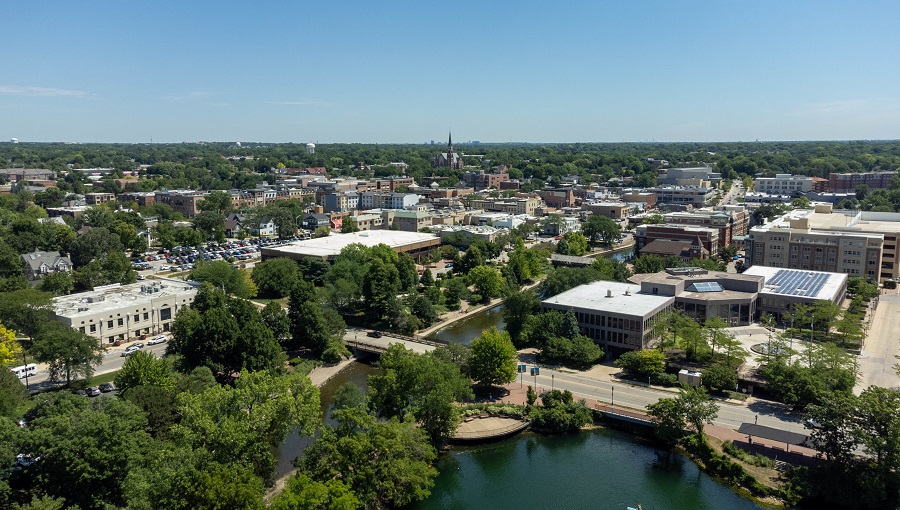
Naperville, located in DuPage and Will Counties, lies 28 miles west of downtown Chicago along the DuPage River. The city’s foundation dates back to 1831, when Joseph Naper, a New York native, settled along the river and founded Naperville. Naper played a pivotal role in its early development, becoming the town’s first landowner and eventually leading its incorporation. In 1842, Naper drew the town’s first plat, and by 1857, Naperville was officially incorporated as a village, with Naper elected as the first president of its board.
The town’s early settlers came primarily from the Northeast. Over time, the population expanded to include people from Pennsylvania, Germany, England, and Scotland. These settlers contributed to the rapid growth of the town, with early institutions such as churches, many of which held services in German, laying the foundation for the community’s cultural diversity.
By the 1830s, Naperville had become a vital stop on the stagecoach routes connecting Chicago with Galena and Ottawa. In 1832, the population had grown to 180 residents. These early residents were industrious, establishing sawmills, gristmills, and other businesses to meet the community’s needs. One of the town’s first notable landmarks, the Pre-Emption House Hotel, became a focal point for travelers. In 1839, when DuPage County was established, Naperville was designated as the county seat, further cementing its importance in the region.
Naperville’s early infrastructure and economy were bolstered by its connection to the Southwest Plank Road, completed in 1851. This road connected Chicago to Naperville and Oswego, serving as a key transportation route for both people and goods. However, at a pivotal moment, Naperville’s business community opposed granting the Galena & Chicago Union Railroad a right-of-way, prompting the railroad to bypass the town and instead go through Wheaton. Naperville missed out on this opportunity for rail access, but in 1864, the Chicago, Burlington & Quincy Railroad passed through Naperville, connecting the town to the broader regional transportation network. This connection played a vital role in Naperville’s expansion over the next century, providing easy access to Chicago and fueling its economic growth.
During this time, several local industries, including stone quarries, flourished, supplying building materials for Chicago, especially in the wake of the Great Chicago Fire of 1871. Additionally, the Stenger Brewery gained prominence, distributing beer across the region. Another major industrial contributor was the Kroehler Manufacturing Company, which became Naperville’s largest employer, producing and shipping furniture to markets throughout the area.
Naperville officially became a city in 1890, with a population of 2,629 by the turn of the century. Between 1890 and 1920, the city saw significant improvements in infrastructure, including the addition of water, sewer systems, electricity, and telephones, which enabled it to grow and modernize. By 1960, the population had reached 12,933.
While Naperville remained relatively unaffected by suburban sprawl in the years following World War II, the East-West Tollway, announced in 1954, drastically changed the city’s trajectory. The tollway, which ran just north of Naperville and connected to the recently completed Eisenhower Expressway, provided direct access to downtown Chicago. This new access contributed to a surge in growth across residential, retail, industrial, and service industries. By 1993, Naperville had expanded to 50 square miles and, by 2000, had a population of 128,358, making it one of the largest and most prominent suburbs of Chicago.
Naperville’s economy further evolved with the establishment of research and development centers, such as the Argonne National Laboratory, Amoco Research Center, Fermi National Accelerator Laboratory, and AT&T Bell Laboratories, in the mid-20th century. These institutions brought a highly educated workforce to the area, contributing to the city’s appeal as a hub for scientific innovation.
Naperville’s rapid development continued as more residential areas were created, particularly by Harold Moser, a prominent figure in local real estate. Moser was responsible for subdividing large tracts of land, building thousands of homes, and contributing to Naperville’s residential growth during the 1950s and beyond.
Today, Naperville is a vibrant community known for its high-quality parks, educational institutions, and cultural offerings. North Central College, originally founded as North Western College, continues to play a key role in the community, while the Naper Settlement, an open-air museum established in 1969, offers a glimpse into the area’s past. The Naperville Riverwalk, developed in the 1980s, has become a focal point of downtown, with its beautiful paths, parks, and historical landmarks.
Naperville’s continued growth has earned it recognition as a highly desirable place to live, attracting residents and businesses seeking proximity to Chicago and the suburbs. The city’s strong economy, commitment to preserving green spaces, and exceptional amenities make it one of the most sought-after communities in the region.
